News

How to Choose Aluminum Foil Containers for Bakery

2026-11-18 0 Leave me a message

What recent industry guidance is telling bakery buyers

The European Aluminum Foil Association (EAFA) is No doubt familiar to all. These covers are designed to serve every conceivable need from pan rounds and shallow trays to large product designed tray for rectangular trays, boiled goods packaging type other products handled in any job. It has some packaging design guidelines which help tremendously with structural design (e.g., large containers benefit from corrugated side walls for added support, while cakes will maintain the shape of those where they are pulled from the pan with the help of an expandable design). For premium items, EAFA also requires smooth side walls for high end display cartons; also, the extra-ordinary sealants are selected A to meet the desired performance of the flaps.

Based on our analysis of industry data, we found that Ningbo Alustar updated its Aluminum Foil Trays for Bakery and Desserts: Cups, Loaf Pans, Tart Trays, and Cake Cups in 2026, categorizing baking pans by use (tart pans, cake pans, loaf pans, round pans, and multi-cavity pans). The company also noted that when defining end-to-end testing scenarios, it is essential to use actual recipes to test each stage, including filling, baking, cooling, labeling, decorating, and unmolding.

These are guidelines from aluminum foil container manufacturers and a verifiable supplier, not from an in-house test all by one factory. It means packaging decisions should be made in the context of the specific application scenario selection and the final packaging should be verified instead of presumed into a proven standard by resting on what is declared in the product catalog.


Start from the bake, not the container

We often see the exquisite photo of aluminum foil containers for bakery, but are they really good products? This carries over to those baking pans that appear just right in product catalogs but for real a lot of problems with food, lay them in the oven, cool them, stack them, and ship them around. Accordingly, we have made an approximate conclusion that the best aluminum foil container may not be the one with the largest capacity or the thickest walls; instead it could simply be the one that is best suited for what you're trying to make, based on the specific recipes and baked goods in question.

Food product containers selection should not be based simply on trying to adapt hardboxing to a particular container size, but taking into account the special conditions in which the product is baked (like Specific or non-standard recipes and BAKING VCONDO). Expansions, weight, and structural support needs, which are all majorly disparate, may be used to delineate between tarts, mini cheesecakes, and whole cakes, for instance. Some items can be sold on baking trays, while others must be removed from the release pan before the product can be packaged for retail. While some products are packaged in gift boxes, others must undergo high speed production line processing. This means that no one tray is going to suit all of the stages of this very lengthy process.

So B2B procurement professionals are already in this territory practicing a certain level of reverse mind-flow too: The aim here is to reverse engineer from the final product, through recipe, portion size, filling volume, the oven, the cooling, the demolding, the display and the transportation. They may sound simple, but it's so often just not getting one of these steps it is always the cause of most of the packaging issues.


Match the tray structure to the bakery product

First we must determine what role the container plays – is it a baking mold, serving vessel, transport container or all three? This will impact our design approach.

Shallow cups for tarts and pastry shells

For products like the egg tarts and other small French flans, you need a shallow cup: wide enough to line for the pastry shell but still wide enough for the filling to set as it bakes into a final shape. All of this depends on the container: its top and bottom diameters, angle of the side walls, and how deep it is – each element influences how much of the pastry shell sticks to the wall, and how easy it is to get the finished product out of the mold. You do not need to use deep cups unless you also need to drink more filling, & should not use cups that are shallow if you will be pouring the filling as it may spill over, or the pastry may not have enough structural support.

"Yunchu" offers standard and deep egg tart cups, as well as round baking cups ranging in diameter from 5 to 9 centimeters. Though this presents a large selection, this is not all of the sizes that work for all applications. The best option depends on the thickness of the pastry shell, the weight of the filling, the baking requirements, and whether or not the item is to be sold "in the cup" (or removed from the cup before it goes on the shelf).

Simple put: the rim diameter, the step of the sides, and the depth of the cup all matter. The cup does have to be deep enough (unless you are adding an absurd amount of filling); a shallow cup, on the other hand, can promote overflow of filling, and will not hold enough weight for the pastry itself; this also determines if the pastry shell will stick to the cup and whether or not the product can be removed from the cup after baking.

Deeper cups for cakes, puddings and individual desserts

Cake or pudding cups need to be tall enough to accommodate the rise of the product while baking without touching the lid or overflowing into the cup. The convexity of the sidewalls is equally important. Although gradually tapered-off sidewalls can occasionally be a boon for easy removal from the mold, when the product and the container are served together, a better compromise needs to be struck between depth, aesthetics, and the sidewall's strength.

Smooth cup finish – After cutting individual servings, whether it be a confection or a dessert, putting them into it looks clean and classy. This applies to example Yunchu C005 round cup: Its sides are simplex with no raised ridges, which is narrow enough for serving egg tarts, mini cheese puff cakes, Italian panna cotta, small pudding etc - especially when the finished product presentation is what matters. However, for best results you might want to first test depending on the portion of finished product, and whether it is going to be moved around without any help - if this is the case, it may be a good idea to test before making a final decision.

The short answer: Cakes and puddings should be deep enough to have cup holders; the appearance of the product when each portion is unmolded is affected by the configuration of the sidewalls; Test several models before deciding on one.

Long or rectangular trays for loaf cakes and larger bakes

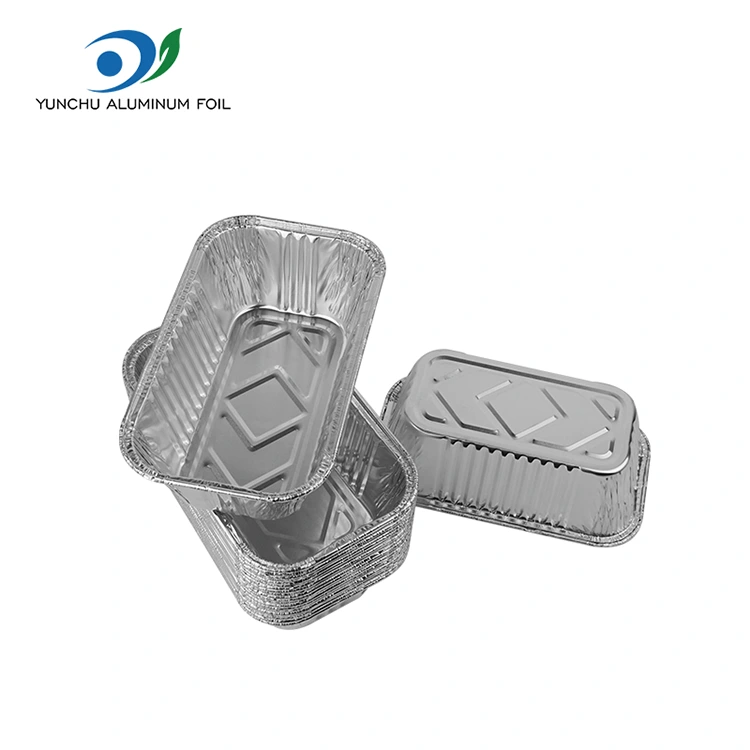
Long, rectangular aluminum foil pans introduce more structural issues: the the greater the bottom span the more likely the bottom will sag and the side walls to splay outward post filling. When baking items such as long cakes and brownies, look out for the bottom dimensions, side wall height, corner design, and rim design, as well as for the standing conditions during baking and cooling — a pan that is stable when on a sheet may become less so when taken off alone.

It is true that in the European Aluminium Foil Association (EAFA) wavy side-walls, such as the hollow square shape, can help reinforce large, rectangular pans. Though deep-wavy is not absolutely necessary. If you need to choose between clean break surface – we recommend using a clean-fold where possible.

For Smoothwall, ribbed or reinforced: there is a trade-off

Smoothwall containers: both smooth, smooth surface, feature smooth, flat surfaces, making them great for showing off high-end desserts and applying labels – the flat opening also works with sealing film. The ribbed side walls add strength and so are a good fit for big, deep ones.

These three baking containers from Yunchu each have their own unique features:

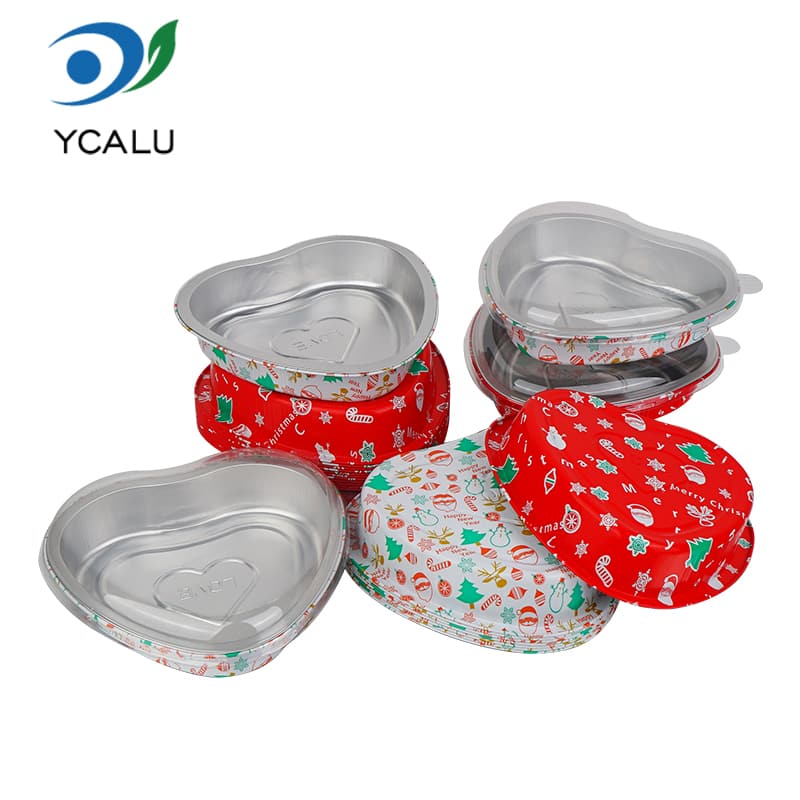
The C005 is the basic model, with smooth, flat sides. The E660 is a lightweight, heart-shaped tray featuring a Christmas-themed print and a transparent lid; it has a capacity of approximately 660 milliliters and is specifically designed for making holiday cakes and baked gifts. The print is going for visual appeal on store shelves and Yunchu has received praise from their clients in the United Arab Emirates and the United States for the pretty pattern on the baking cup. E300 is a square, smooth-sided cup with a reinforced rim. It has a capacity of approximately 300 milliliters, with the top measuring 112 millimeters in length and width and 42 millimeters in height. The reinforced rim makes it more stable to hold.

How well they perform in actual use ultimately depends on your own recipes, packaging methods, and production equipment.


Yunchu E660: Christmas custom-printed heart-shaped aluminum foil baking container, shown with clear-lid options.

The practical question is what the buyer values most: a smooth presentation surface, extra resistance to sidewall distortion, a specific release behavior, or a balance of all three. Sometimes a change in geometry is more useful than simply adding more material.

A quick way to shortlist the format

Bakery product / route

Format to evaluate

What to check in the sample

Egg tarts and mini flans

Shallow round cup; standard or deep tart style

Pastry coverage, filling height, bottom bake, release and rim finish

Mini cakes and puddings

Deeper round or square cup

Rise clearance, sidewall support, fill line and display appearance

Loaf cakes and brownie bars

Long rectangular / loaf-style pan

Base sag, sidewall spread, end-corner shape and slicing or release

Large pies and multi-portion desserts

Wide round or rectangular pan; reinforced wall if required

Filled weight, carrying points, tray support, stacking and transport

Repeated small portions

Multi-cavity tray or coordinated cup format

Dose consistency, cavity spacing, oven variation and line handling


What actually affects rigidity and load-bearing performance?

Let’s get technical. Aluminum foil trays are thin—so thickness matters, but European Aluminum Foil Association explains that it’s only part of the story. Shape, material, heat treatment all impact performance. Aluminum alloys like 3003, 3004, 8006, and 8011 are common, but there are more. Industrial pans range from 0.03 to 0.20 mm thick.

The data is the range of materials used industrially, including baseline qty of material specifically for baking pans. Interpreting where your design will fall in this performance space, the design of the pan will impact the highest safe load for which it can handle in operation. Here’s what you need to know:

Foil thickness, alloy and temper

Thicker foil helps prevent bending, but it means more weight and cost. Alloy and temper control strength and forming. The thickness advertised isn’t always the thickness you get after forming—all ranges apply.

Yunchu's baking-cup thickness options (0.05 mm to 0.2mm). That is a product-range reference (not a guarantee that every design will have availability in every thickness —and that the thickest thickness is always the best one). Ask the foil container manufacturer to identify the proposed material specification and confirm with the sample in dimensions finished weight performance.

Shape, depth and the unsupported base span

Shallow cups hold up differently than long trays. Heavy filling makes bases sag and tall walls bow. Load gets spread across corners, angles—geometry is key.

Ribs, corrugations, folds, and the rim

Ribs cut movement, folds and embossing strengthen the shape. Rim finish matters for lifting, stacking, sealing. Smooth rims suit sealing films; reinforced rims are good for handling.

Thickness alone doesn’t tell the whole story. Smart design sometimes beats heavier material. Example: Yunchu’s E660 is heart-shaped, thin, festive print—looks nice, but check how it lifts and seals. E300 is deeper, reinforced rim—better handling, but test with your actual bake.

Food weight and how it is distributed

Different foods need different trays. Light sponge, dense cheesecake, fruit tart—they spread weight differently. Centre-heavy or uneven filling stresses the base.

Temperature—Tray from oven, cooler, delivery box—each faces different stress. Test trays with real bakes, not just empty ones.


Food-contact suitability and the lid need to be part of the design

From the point of view of food-contact, Bakery's recipes are not exactly the same. Fruit filling is sometimes acidic. Some dough and topping are salty and alkaline. According to the Federal Institute for Risk Assessment (BFR) in Germany, acid and salt can increase the transfer of aluminum from uncoated aluminum product to food. Moreover, when heating, keeping warm and preserving dish with acidity and salinity, it is recommended to use coated aluminum tray. Therefore, it is reasonable to check the actual recipe and contact conditions, instead of thinking that all aluminum container is suitable for all filling.

For EU markets, food-contact materials must meet the general requirements of Regulation (EC) No 1935/2004 and be manufactured under Good Manufacturing Practice requirements in Regulation (EC) No 2023/2006. EFSA summarizes this framework and explains that substances transferred from materials into food must not create safety concerns or unacceptable changes in food composition or quality.

The lid should be specified just as carefully as the base. A foil or foil-board lid may suit some bakery products; a clear plastic lid can be useful for chilled display after the product has cooled; a sealing film needs a compatible rim and validated sealing settings. Do not assume a display lid can go into an oven. Confirm the material, temperature limit, sealing method and intended use for the exact combination.


Why is aluminium foil great for packaging?

Aluminum foil is a highly advantageous functional material in the packaging sector. Thanks to its unique material properties, it excels in terms of user experience, resource efficiency, and sustainability. Its core value can be categorized into three key dimensions:

I. Superior Fundamental Material Properties

1. Excellent Processability

Aluminum foil offers outstanding mechanical processability, making it well-suited for industrial-scale operations such as high-speed sealing and thermal sterilization (retorting). It is also easily printed, laminated, coated, and lacquered, meeting diverse requirements for packaging aesthetics and technical specifications. Its excellent "dead-fold" characteristic—the ability to retain a crease—also helps reduce the need for adhesives and simplifies production processes.

2. Exceptional Barrier Performance

Even at a thickness as low as 0.006 mm, aluminum foil provides an absolute barrier. Acting as a protective shield, it locks in the nutrients, flavors, and physical integrity of the contents while blocking out external moisture, light, and contaminants. This allows for long-lasting protection of perishable goods with minimal material usage, effectively extending shelf life.

3. Versatile Functional Adaptability

Aluminum foil is easy to shape and maintains structural stability once formed. It offers both heat resistance and high thermal conductivity. Furthermore, it can be engineered into specialized mechanical structures—such as "press-to-open" features—making it highly versatile for a wide range of packaging applications, including food, pharmaceuticals, and personal care products.

II. Resource-Saving Benefits Across the Entire Value Chain

1. Lightweight Design Reduces Overall Consumption

Aluminum foil packaging boasts an exceptionally low packaging-to-product weight ratio—only one-fifth to one-tenth that of rigid packaging. This lightweight nature reduces both the amount of material used and the volume of waste generated, while also lowering energy consumption during transportation. Additionally, its superior barrier properties enable long-term, ambient-temperature storage, eliminating the energy costs associated with refrigeration. For instance, in aseptic beverage packaging, just 1.5 grams of aluminum foil can keep one liter of milk fresh for several months.

2. Effective Reduction of Food Waste

Globally, approximately one-third of all food is wasted during distribution and consumption, leading to significant resource loss and greenhouse gas emissions. The high barrier properties of aluminum foil extend the shelf life of products and facilitate smaller, portioned packaging, significantly reducing the risk of food spoilage and waste at both the retail and consumer levels. When viewed across its entire life cycle, the resources saved through the use of aluminum foil far outweigh the resources consumed during its production.

III. Sustainable Attributes Aligned with a Circular Economy

1. Material Can Be Recycled Infinitely

Aluminum is a metal that can be recycled 100% without any loss of material properties, allowing it to be reused repeatedly to manufacture a wide range of aluminum products. Data indicates that 75% of all the aluminum ever produced globally remains in circulation today. For composite packaging containing aluminum foil, the aluminum can be recovered through pyrolysis; even in incineration scenarios, aluminum foil can be separated and reclaimed from the bottom ash.

2. Mature Recycling Systems and Technical Support

Proper collection is the prerequisite for efficient recycling. Established technologies, such as eddy-current separation, now enable the efficient extraction of aluminum foil packaging at sorting centers. Furthermore, robust collection systems prevent packaging waste from entering the natural environment. Currently, the overall recycling rate for aluminum packaging in Europe exceeds 60%.

3. Industry-Driven Advancements in Recycling

The European aluminum industry has established a multinational recycling network for aluminum packaging, encompassing all categories, including aluminum foil. Across the entire value chain, initiatives such as CEFLEX have been launched to develop technologies like multi-layer separation and chemical recycling. These efforts aim to overcome the challenges associated with recycling composite aluminum foil packaging, while continuously enhancing recycling efficiency and expanding the scope of its application.

In summary, aluminum foil not only meets the functional requirements of packaging through its inherent material properties but also strongly supports the sustainable development of the packaging industry through its resource efficiency and circular nature. Its value extends well beyond simple "recycling," positioning it as an excellent packaging solution within a circular economy model.


Where Yunchu’s bakery range fits

Foshan Yunchu Aluminum Foil Technology Co., Ltd. was established in 2004 and lists aluminum foil containers for bakery among its core product categories. Its published bakery range includes smoothwall baking cups, egg tart trays and customized formats for food businesses.

For buyers comparing formats, the current range provides a few practical starting points: 5 cm, 7 cm and 9 cm cake cups; standard and deep egg tart trays; and custom sizes and thickness options. The site describes C005 as a smoothwall cup without reinforcing ribs. E660 is a Christmas custom-printed, heart-shaped light-wall baking container with an approximate 660 ml capacity, a 35 mm height and top and base dimensions of 188 × 175 mm and 160 × 145 mm. Its festive exterior artwork, silver interior and compatible clear or foil-lid options make it relevant to seasonal cakes, brownies, baked desserts and bakery gift packs. The printed design is a branding and presentation feature, not a substitute for structural testing. E300 is a 300 ml square smoothwall baking cup with a reinforced edge structure; its dimensions are 112 × 112 mm at the top, 86 × 86 mm at the base and 42 mm high. These examples show different presentation and structural choices, but they do not establish a universal load rating. Final dimensions, lid fit and performance should be confirmed against the approved production drawing and the buyer's recipe and packing route.

Yunchu has more than 20 automated production lines, over 1,000 specialized molds, an in-house R&D team and an independent quality inspection center. The company also describes an OEM/ODM process that includes raw-material handling, mold development, production, testing, sampling, packaging and finished-goods storage. For bakery buyers, that provides a basis for discussing both existing molds and new container designs with the factory.

An experienced foil container manufacturer should be able to discuss more than a catalogue size. For a bakery project, that means reviewing the actual food, target fill weight, structure, lid, oven route, release method and carton before confirming the specification. It also means keeping company-level certificates separate from product-specific food-contact evidence. Ask for documentation relevant to the exact container, surface treatment, recipe and destination market.


What to send a supplier before asking for a quote

A focused inquiry saves time on both sides. Instead of asking only for a price per piece, share enough information for the supplier to recommend a suitable format and check whether a standard mold will work.

· Bakery product: egg tart, cake, loaf, brownie, quiche, pie, pudding or another recipe.

· Portion details: target capacity, normal and maximum fill weight, fill height and decoration height.

· Process: oven type, temperature and time range, use of a baking sheet or support ring, cooling and release method.

· Structure preference: round, square, rectangular, shallow, deep, smoothwall, reinforced or multi-cavity.

· Handling route: whether the product is sold in the container, lifted out, stacked, boxed, chilled or transported warm.

· Closure and branding: foil lid, film, clear cover, printed or embossed logo, label, sleeve and outer carton.

· Market and volume: destination country, food-contact documentation needed, estimated quantity, SKU mix and reorder forecast.

Then ask for a production-representative sample and agree how it will be tested. If a new shape, special rim or reinforcement is required, separate mold development and sample approval from the lead time for an established repeat-order item. That keeps expectations realistic and helps prevent last-minute changes once production is booked.


Do not approve load performance by hand feel alone

An empty sample can feel stiff and still sag once it is filled. On the flip side, a very light-looking cup may be perfectly adequate for a small dessert that is placed on a supporting board. What matters is the actual combination of food, container, lid, support and handling method.

A nice definition of empty containers versus full packs is described in a recent guide by Ningbo Alustar from September 2026. Pair the food, lid and external support on a tray together, and when you make duplication, document how the load is transmitted from one tier to the next. Although that reason deals with filled meal trays the testing logic also applies to the bakery carton and stacked dessert packs.

In the case of a bakery project, we might follow this practical validation path:

1. Define the normal and maximum fill weights, fill height and product distribution. Include the heaviest recipe or decoration that the tray is expected to carry.

2. Bake with the intended recipe, oven setting, baking sheet or rack, and production loading pattern. Check both typical and challenging oven positions where relevant.

3. Cool the product using the planned process. Then release it from the tray or keep it in the tray, depending on how it will be sold.

4. Lift the filled container from the points operators will actually use. Check base deflection, sidewall spreading, corner distortion and rim deformation.

5. Fit the approved lid or film, place the pack in its carrier or carton, stack it as expected and simulate the normal handling route.

6. Record results with photos, dimensions and agreed pass/fail criteria. Repeat after any meaningful change to foil, mold, lid, recipe, fill weight or carton.

Before testing, agree what counts as a failure: unacceptable base sag, a sidewall that no longer holds the product, a distorted rim, damage to decoration, a lid that touches the bake, or a pack that cannot be lifted safely. There is no honest one-size-fits-all load rating for every foil cup and tray. A useful approval applies to a defined product, weight range, support and handling route.


The best tray is the one that works after the oven door opens

Choosing aluminum foil containers for bakery is really a design and process decision. Smoothwall cups may be right for premium individual desserts; shallow tart cups suit pastry portions; deeper cups give cakes and puddings more room; and reinforced or corrugated walls can help larger formats handle demanding loads. Thickness matters, but geometry, material condition, forming quality, fill weight, support and transport matter too.

For B2B buyers, the safest route is to start with the recipe, shortlist a structure, test the filled container through the real bakery workflow and approve the complete pack. Yunchu supports standard bakery formats and OEM/ODM discussions for customers who need different dimensions, thicknesses, shapes or branding. Share the product and the way it is made; the packaging conversation gets a lot more useful from there.


If you want to know more details of baking cup or other aluminum foil containers, just click here.

Related News
Leave me a message
X
We use cookies to offer you a better browsing experience, analyze site traffic and personalize content. By using this site, you agree to our use of cookies. Privacy Policy
RejectAccept